

 English

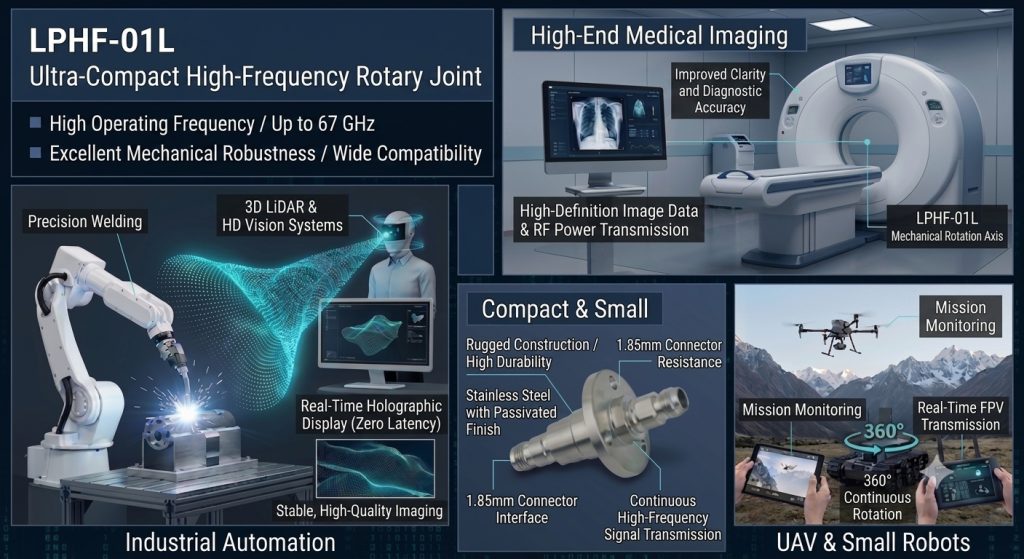
Model: LPHF-01L Frequency Range: DC to 67 GHz Connector: 1.85 mm Coaxial Impedance: 50 Ω Applications: 5G Communication · Millimeter-Wave Radar · Medical CT · Industrial 3D Imaging · UAV · Satellite Communication
A high-frequency slip ring — also called an RF slip ring or coaxial rotary joint — is a precision rotating connection component that transmits microwave and millimeter-wave signals continuously across a rotating mechanical interface.
Where conventional electrical slip rings handle power or low-frequency data, high-frequency slip rings are designed for GHz-band signals. The JINPAT LPHF-01L operates from DC up to 67 GHz, placing it at the frontier of commercially available rotary RF components.
Typical use cases include:
High-frequency signals are extremely sensitive to reflections at impedance discontinuities. The LPHF-01L maintains a characteristic impedance of 50 Ω across the entire rotating junction. Precise coaxial geometry and tight dimensional tolerances minimize signal reflection (VSWR) and prevent standing wave formation that would degrade signal integrity.
Every transmission medium introduces some signal attenuation. At millimeter-wave frequencies, even small geometric imperfections or material choices can produce significant loss. The LPHF-01L’s precision coaxial nested structure keeps insertion loss to a minimum across the full DC–67 GHz operating range.
For multi-channel configurations, shielding design becomes critical to prevent inter-channel signal interference. The coaxial construction of the LPHF-01L provides inherent electromagnetic shielding between the signal path and the external environment.
The LPHF-01L is built on a coaxial architecture: a central inner conductor surrounded by a concentric outer conductor, separated by a precisely controlled dielectric. This geometry creates a uniform electromagnetic field distribution along the signal path, which is what makes stable high-frequency transmission possible through a rotating contact.
The symmetry of the coaxial structure is not incidental — it is the primary engineering mechanism by which the LPHF-01L achieves 67 GHz performance. Any deviation in concentricity, surface finish, or dielectric uniformity at the rotating interface directly affects signal quality at millimeter-wave frequencies.
The 1.85 mm connector (also known as the V-connector) is a precision RF interface standardized for operation up to 67 GHz. In the LPHF-01L, it serves as the signal entry and exit point on both the rotor and stator sides.
Key characteristics of the 1.85 mm interface:
For 5G FR2 band (24–71 GHz) and radar applications, the 1.85 mm connector is the enabling interface that makes 67 GHz rotary transmission achievable in a compact package.
Understanding failure modes is as important as understanding performance. In high-frequency slip rings, the following factors most commonly affect signal quality:
Mechanical Misalignment — Any eccentricity between the rotating and stationary conductors creates a periodic impedance variation that appears as amplitude modulation on the transmitted signal. The LPHF-01L’s coaxial nested design minimizes this risk through tight manufacturing tolerances.
Contact Surface Wear — Repeated rotation gradually changes the surface condition of the conductor contact interface, which can increase insertion loss over time. The beryllium copper inner conductor of the LPHF-01L provides high fatigue resistance and maintains stable contact characteristics over a high number of cycles.
Dielectric Material Loss — At millimeter-wave frequencies, the dielectric constant and loss tangent of insulating materials directly affect signal transmission. Material selection in the LPHF-01L is optimized for the operating frequency range.
The LPHF-01L reflects several deliberate engineering choices that distinguish it from lower-frequency rotary joints:
Passivated Stainless Steel Outer Conductor — Stainless steel provides the mechanical rigidity needed to maintain coaxial geometry under rotation, vibration, and thermal cycling. Passivation treatment enhances corrosion resistance for operation in demanding environments.
Beryllium Copper Inner Conductor — Beryllium copper combines high electrical conductivity with exceptional spring properties and fatigue strength — qualities essential for a contact surface that must maintain stable impedance through continuous rotational wear.
Coaxial Nested Construction — The nested coaxial layout keeps the overall assembly compact and lightweight, directly enabling integration into space-constrained platforms such as UAV payloads, robotic joints, and portable instruments.
Industrial robots equipped with 3D LiDAR scanners and high-definition vision modules generate continuous streams of point cloud and image data that must be transmitted in real time throughout the full range of arm rotation. The LPHF-01L provides the rotating RF link that sustains this data flow without interruption, preserving the timing precision required for precision sorting, welding, and assembly operations.
The same performance characteristics apply to industrial 3D imaging systems and non-destructive testing (NDT) instruments — including ultrasonic phased-array scanners and millimeter-wave inspection systems — where high-speed rotation and ultra-high-frequency signal transmission are simultaneous requirements.
In a CT scanner, the X-ray source and detector array rotate continuously around the patient at high speed while the examination table remains stationary. RF energy and high-resolution image data must cross this rotating interface without loss or interruption. The LPHF-01L’s 67 GHz capability and low-loss coaxial structure provide the rotating RF coupling between gantry and fixed frame, directly affecting image resolution and diagnostic accuracy. It is a core rotating connection component in modern high-precision medical imaging systems.
The LPHF-01L’s compact coaxially nested design and low mass make it well-suited for UAV sensor payloads, gimbal stabilization systems, and small robotic joints where weight and volume are hard constraints. During rapid attitude changes, rotational scanning maneuvers, or continuous 360° operation, the LPHF-01L maintains stable millimeter-wave signal connectivity — preventing signal dropout or latency that would compromise mission performance.
Phased-array radar antennas and satellite communication terminals frequently require continuous azimuth rotation for scanning or beam steering. The LPHF-01L enables high-fidelity RF transmission across the rotating junction, supporting wideband radar waveforms and high-throughput satellite uplink/downlink channels up to 67 GHz.
The JINPAT LPHF-01L is a 67 GHz single-channel RF slip ring built around a 1.85 mm coaxial interface, precision coaxial nested construction, passivated stainless steel outer conductor, and beryllium copper inner conductor.
Its 67 GHz frequency ceiling, 2.4 mm mechanical compatibility, miniaturized form factor, and high-cycle durability make it a reliable rotary signal connector for engineers and system integrators working at the millimeter-wave frontier — in radar, 5G, satellite communication, medical imaging, industrial robotics, and UAV applications.
As millimeter-wave technology continues to expand into commercial infrastructure, the importance of reliable rotating RF components at these frequencies will only grow. The LPHF-01L is designed to meet that demand.
For technical consultation or product inquiries, contact JINPAT Electronics: sales@jinpat-electronics.com
Keywords: 67GHz slip ring, RF slip ring, coaxial rotary joint, 1.85mm connector slip ring, millimeter wave rotary joint, high frequency slip ring, LPHF-01L, JINPAT, 5G rotary joint, CT scanner slip ring, radar slip ring, UAV slip ring