
 English

A Service Plan for USB and Power Paths in Test Turntables Record a commissioning baseline Make future faults comparable At installation, capture the approved wiring map, USB device, host configuration, cable lengths and test results in a known turntable position. Repeat the check during the specified motion. This baseline becomes the reference for later service. […]
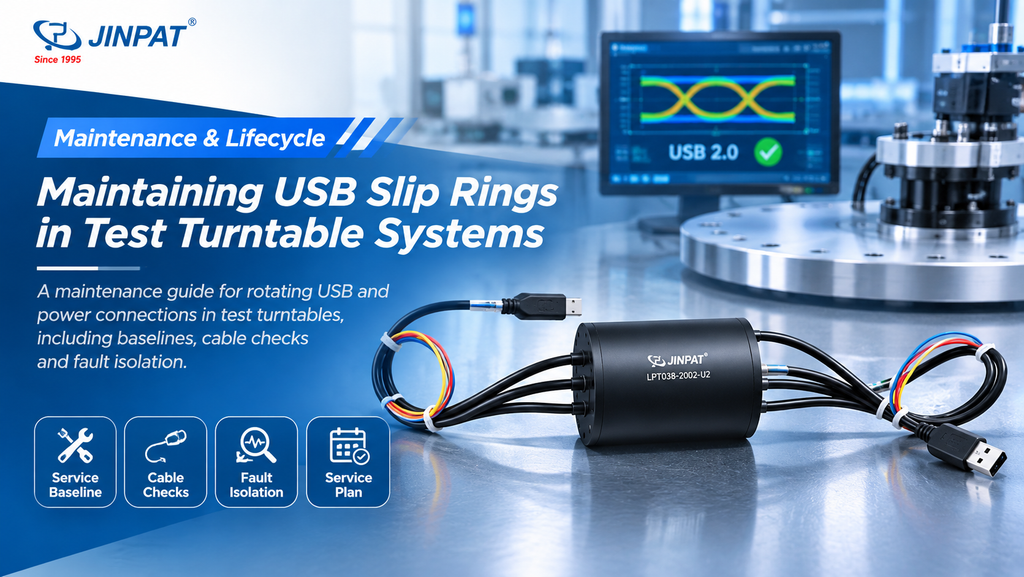
At installation, capture the approved wiring map, USB device, host configuration, cable lengths and test results in a known turntable position. Repeat the check during the specified motion. This baseline becomes the reference for later service. Without it, a field engineer may not know whether a USB interruption is new or was present from the first build. Keep the drawing revision and any approved substitute parts with the record.
Routine inspection should cover cable strain, connector seating, abrasion and routing on both sides of the rotary interface. The 38.1 mm bore is a packaging feature, not permission to crowd the center with unrestrained cables. Look for contact between the moving fixture and external harness. Follow the machine maker’s isolation procedure before disconnecting equipment. The source sheet does not specify an inspection interval for this exact unit, so set one from duty cycle, access and operating history.
If a device disconnects during rotation, record the turntable position, direction, speed and the host event log. Check external connectors and cables before replacing the slip ring. Repeat a controlled test with the same device and software version. If failures occur only with certain loads energized, investigate the complete electrical arrangement and grounding. A symptom may involve several parts of the chain; documenting the conditions saves time during supplier review.
The product record states twenty 2 A circuits. A fault on one assigned circuit does not prove every path has the same condition. Map the affected function to its circuit number and use the approved test procedure. Record measured values and their limits rather than simply writing “good” or “bad.” This lets engineering see whether the issue is at a connector, a harness segment, the rotating interface or the device itself.
A spare must match the electrical schedule, USB connection and mounting arrangement actually installed. Store the mating connector information and drawing revision with the spare. If the supplier proposes a changed cable exit or circuit allocation, engineering should review the affected installation and acceptance tests. The source does not establish a universal life figure, so a fixed replacement schedule should not be invented for a public maintenance article.
International teams supporting Russian projects may face long travel and demanding environments. This is a planning consideration, not proof of a temperature or ingress rating for the selected slip ring. Include the expected storage and operating conditions in the project specification and obtain written confirmation for the final design. Bring the relevant test method and documentation to the first site visit, especially where a return trip is expensive.
A service team should have the approved drawing, pin map, test procedure, replacement connectors and access instructions before visiting a remote site. If a spare unit is carried, verify its revision and harness configuration. A generic spare may fit mechanically but have a different circuit assignment. Document what can be tested without removing the unit and which checks require the equipment to be isolated. This preparation is particularly valuable when equipment is far from an engineering center.
If the maintenance plan includes periodic measurements, use the same test points, device and motion conditions each time. A result taken with a different USB peripheral or cable may not be comparable to the commissioning baseline. Record any fixture or software change. Trends can help determine whether a symptom is developing, but they should not be presented as a prediction of remaining life without validated data for the actual configuration.
Preventive inspection may reveal a cable beginning to rub or a connector that is not fully seated. Correct those installation issues according to the approved maintenance procedure. If a data fault has already occurred, preserve the logs and test the affected path before replacing parts. Replacing a rotary unit without checking the peripheral and harness can consume a valuable spare while leaving the original fault. The service article should show this sequence rather than promising “maintenance-free” use.
A turntable could be used in a controlled laboratory or a more demanding installation. The source row does not state a temperature range or IP rating for this particular model. If a Russian project requires cold storage, humidity control or other environmental performance, those conditions belong in the purchase specification and qualification plan. Do not transfer a rating from another LPT-series model. Maintain records of storage and installation conditions so unexplained failures can be assessed against actual use.
A good case report contains the equipment identifier, slip-ring revision, symptom, turntable position, USB host and device, test method, findings and corrective action. It should state whether the problem was reproduced after repair. This record enables the supplier and machine builder to compare incidents across sites and identify a recurring harness or configuration issue. In a multilingual service organization, standardized fields are more reliable than a free-form note that omits the crucial operating conditions.
When a site reports a problem, ask for the equipment serial number, drawing revision, USB host and device, exact symptom and whether the fault changes with turntable position. Request logs and photos of accessible external connectors where permitted. This information can guide a remote diagnostic session and reduce unnecessary replacement shipments. If the case cannot be resolved remotely, the visiting engineer will have a focused test plan rather than beginning with a broad description of “unreliable data.”
After replacing a cable, connector or slip ring, repeat the test that reproduced the fault and the relevant commissioning checks. Record the same turntable positions, USB device and electrical loads where practical. A repaired system should be judged against the approved acceptance criteria, not only by a brief demonstration that the screen now shows data. Update the service log with the installed revision and any changed routing so future visits start from accurate information.
Editorial note: The source row records a 38.1 mm through bore, 20 circuits rated 2 A, one USB 2.0 group, turntable use and cut-out watermarked images. Confirm all final electrical and mechanical limits against an approved drawing before publication. Do not show the internal project code.
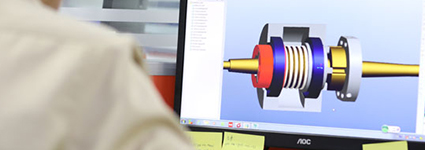
JINPAT photovoltaic slip rings have high quality and competitive price. JINPAT has provided hundreds of models of electro-optical rotary joints for both civil and military industries. Most of JINPAT electro-optical slip rings have high transmission capacity. High-end slip rings can transmit 4K@60FPS high-definition video signals. OVERVIEW Design product sketches and models using SOLIDWORKS 3D Computer […]

With many years of experience in managing various types of projects, the management team of JINPAT is able to eliminate all obstacles that arise during the execution of projects to ensure that the technology is followed and the products are manufactured successfully. In addition, JINPAT understands the importance of good documentation. Documents such as certificates […]
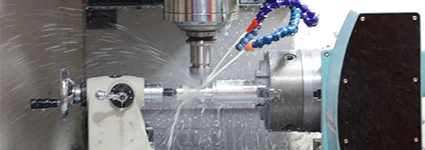
JINPAT carries out precision machining of all components of its products. At all stages of production, from drawing to molding, JINPAT is committed to being precise and ensuring that the best slip rings are produced. With the ability to machine parts to a tolerance of 5 microns, our experienced, highly skilled team uses the latest […]

JINPAT welding technicians are experts in Gas Metal Arc Welding (GMAW), Flux Cored Arc Welding (FCAW), Gas Tungsten Arc Welding (GTAW) and Semi Metal Arc Welding (SMAW). They are dedicated individuals who value precision and aesthetics in the production of machine components. OVERVIEW Welding procedures comply with codes such as ASMEIX, AWS, DIN, API, B31.1, […]

JINPATElectronics is a customer-oriented corporation. We do our utmost to provide our customers with high-standard solutions for transmission including rotation. Up to now, JINPAT has provided its services to more than 10,000 customers worldwide. Each slip ring produced by JINPAT undergoes a series of rigorous and systematic inspections and durability tests before being delivered to […]
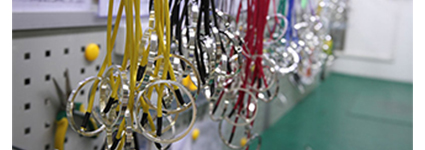
With advanced testing and measuring devices, JINPAT’s Quality Control Department conducts systematic inspections of our products. Our quality measurement system complies with ISO 9001:2015. JINPAT has great confidence in its products and has earned a good reputation for producing products of unrivaled quality. REVIEW Detailed inspection and provision of data in the form of documentation […]