
 English

Define the installed configuration first Maintenance advice is only useful when it matches the installed assembly. Record the slip ring revision, reel arrangement, circuit schedule, high-frequency cable and connectors before setting inspection tasks. The available JINPAT record identifies a compact cable-reel unit with one integrated high-frequency path; it provides no universal maintenance interval or service-life […]
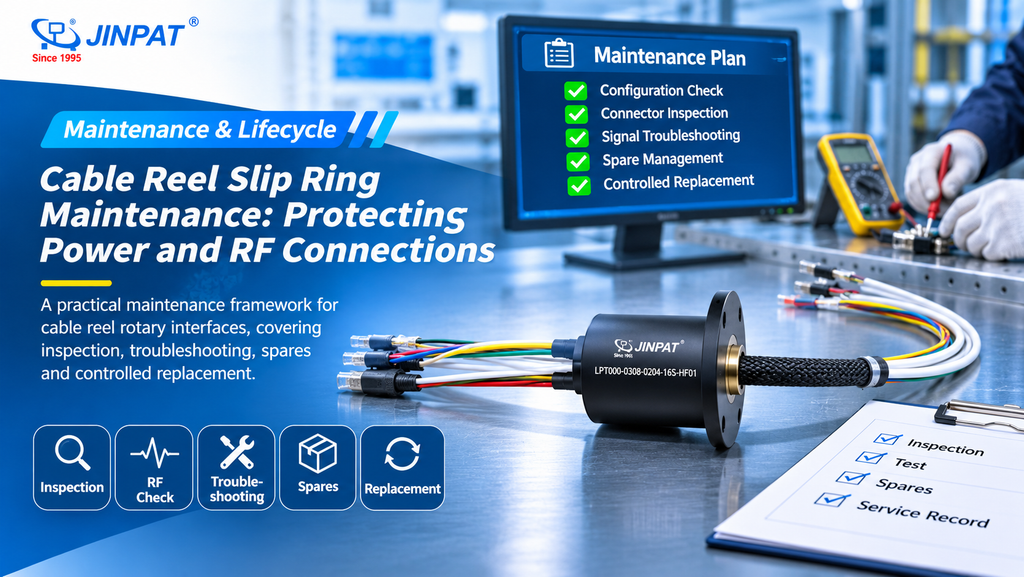
Maintenance advice is only useful when it matches the installed assembly. Record the slip ring revision, reel arrangement, circuit schedule, high-frequency cable and connectors before setting inspection tasks. The available JINPAT record identifies a compact cable-reel unit with one integrated high-frequency path; it provides no universal maintenance interval or service-life figure.
Use the machine builder’s duty cycle and the supplier’s released instructions to set intervals. A service team should not inherit a generic replacement schedule that ignores how frequently the reel actually moves.
Many apparent rotary-interface faults begin outside the component. Look for abrasion at the reel edge, damaged jacket, tight bends, loose clamps and movement at terminations. Check both the fixed and rotating sides through the permitted range of travel.
Note whether the symptom occurs at a particular reel position. Restore safe isolation before touching connections, following the machine maker’s procedure. Do not assume that a visual inspection proves the conductor or shield is sound; use an appropriate electrical test when the symptom calls for one.
The high-frequency path deserves its own service record. Identify the specified cable type, mating connector, assembly length and routing. A replacement that looks similar can change the measured link. Check connectors for contamination, mechanical damage and secure mating using the approved handling procedure. Avoid cleaning or reworking a connector without a defined method. When a signal fault appears after maintenance, compare the current cable and connector identifiers with the last accepted configuration before blaming the rotary unit.
Start with the observed machine symptom: lost power, intermittent control or degraded high-frequency performance. Confirm the load and equipment state, then test the external harness and accessible connectors. Verify the relevant individual circuit or signal path under the conditions that reproduce the issue. If a bench result differs from an in-motion result, log reel position, speed and cable movement. Only after isolating those variables should the team remove or replace the rotary interface. This sequence reduces unnecessary parts changes and protects evidence for root-cause analysis.
A signal measurement becomes more useful when the service team can compare it with a recorded acceptance result. Store the test method, instrument, reference planes, cable lengths and machine state. If the high-frequency requirement is application-specific, compare the exact metric selected for that application. Do not infer a published insertion-loss or bandwidth limit from this article: the source row does not contain one. Where no baseline exists, establish one on a known-good approved configuration and document the limitations of that comparison.
A spare slip ring should match more than a family name. Verify the mechanical interface, cable exit, circuit assignment, high-frequency connector and revision against the installed drawing. Keep the spare protected and labeled according to the supplier’s storage instructions. If a substitute is proposed, obtain engineering disposition for any difference and repeat affected acceptance tests. A service stock that silently mixes revisions can turn a straightforward field replacement into a prolonged fault investigation.
A useful service entry includes the machine identifier, reel location, symptom, conditions, inspection findings, measurements, parts removed, parts installed and result after restart. Attach photographs of the external routing where permitted, but do not publish internal project labels or sensitive customer information. If several sites use similar reels, consistent records make patterns visible: one harness route may repeatedly abrade, or one connector procedure may need clarification. The record should support engineering learning, not just close a maintenance ticket.
A cable reel may face dust, moisture, vibration or temperature swings, depending on installation. The selected workbook row does not state an environmental or ingress-protection rating for this exact product. Specify those conditions at machine level and obtain the approved limits before deployment. For Russian projects, especially where equipment may be stored or operated in cold locations, verify temperature and material suitability against project evidence. Do not transfer a cold-weather or IP claim from another slip-ring model.
Changing the reel drive, cable, connector or mounting bracket can change the stresses seen by the interface. Review inspection points after such a change and decide whether the former baseline remains valid. If a high-frequency path is rerouted, verify it with the application measurement rather than only a continuity check. Keep the final as-built drawing available to the maintenance team. A controlled change process often prevents more downtime than an aggressive but unsupported promise of maintenance-free operation.
This compact integrated option may reduce the number of separate interfaces in a reel, but service reliability still depends on cable routing, connection quality and documented acceptance. Set inspection intervals from the actual duty, hold spares against the released configuration and diagnose faults from the outside inward. Ask JINPAT for the approved drawing and product-specific service guidance before publishing a life claim or fixing a replacement interval. That approach gives the operator a maintainable system rather than a marketing promise.
After an intervention, inspect the cable route again, reconnect under the approved procedure and run the same checks used to release the system. Record whether the original symptom disappeared under the same reel motion and load conditions. If a spare was fitted, retain the removed unit and its identification until the cause is understood. A restart that merely powers on can conceal an intermittent fault. Closing the job with comparable evidence helps separate a genuine repair from a temporary recovery.
When a service team cannot isolate the issue locally, send the supplier a concise evidence package: installed drawing revision, symptom timeline, reel positions, motion profile, external cable inspection, connector identification and measured results. Remove customer-sensitive identifiers from any public material, while keeping them in the private support case where permitted. A reproducible description lets engineering assess the actual failure mode. It is more useful than a request for a replacement based solely on the phrase intermittent signal.
JINPAT photovoltaic slip rings have high quality and competitive price. JINPAT has provided hundreds of models of electro-optical rotary joints for both civil and military industries. Most of JINPAT electro-optical slip rings have high transmission capacity. High-end slip rings can transmit 4K@60FPS high-definition video signals. OVERVIEW Design product sketches and models using SOLIDWORKS 3D Computer […]

With many years of experience in managing various types of projects, the management team of JINPAT is able to eliminate all obstacles that arise during the execution of projects to ensure that the technology is followed and the products are manufactured successfully. In addition, JINPAT understands the importance of good documentation. Documents such as certificates […]
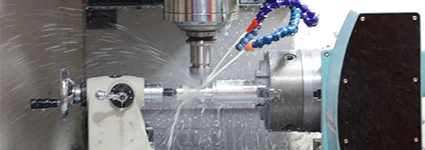
JINPAT carries out precision machining of all components of its products. At all stages of production, from drawing to molding, JINPAT is committed to being precise and ensuring that the best slip rings are produced. With the ability to machine parts to a tolerance of 5 microns, our experienced, highly skilled team uses the latest […]

JINPAT welding technicians are experts in Gas Metal Arc Welding (GMAW), Flux Cored Arc Welding (FCAW), Gas Tungsten Arc Welding (GTAW) and Semi Metal Arc Welding (SMAW). They are dedicated individuals who value precision and aesthetics in the production of machine components. OVERVIEW Welding procedures comply with codes such as ASMEIX, AWS, DIN, API, B31.1, […]

JINPATElectronics is a customer-oriented corporation. We do our utmost to provide our customers with high-standard solutions for transmission including rotation. Up to now, JINPAT has provided its services to more than 10,000 customers worldwide. Each slip ring produced by JINPAT undergoes a series of rigorous and systematic inspections and durability tests before being delivered to […]
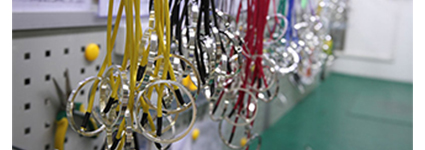
With advanced testing and measuring devices, JINPAT’s Quality Control Department conducts systematic inspections of our products. Our quality measurement system complies with ISO 9001:2015. JINPAT has great confidence in its products and has earned a good reputation for producing products of unrivaled quality. REVIEW Detailed inspection and provision of data in the form of documentation […]